skip to main |
skip to sidebar
 Africa is either really cheap or really expensive to visit because it takes a month to be able to interpret your environment enough that you can get around on your own. If you don’t have a month, you need an expensive guide to interpret your environment for you. One Ghanaian friend who had lived in Germany for several years said it very simply – your world is user-friendly, while mine is friendly.
Safety – above anything, safety is expensive. It often feels like life here in Ghana is considered less valuable than the cost of installing seatbelts or paying police officers properly so that they stop accepting bribes from commercial vehicles that overload their trucks and kill 170 people in the month of November in my region alone when their brakes fail or when they overtake weaker vehicles.
Comfort – when you take the entire cost of running a vehicle from point A to point B, and divide it between the maximum allowed occupancy of the vehicle, the cost would be too high for most Ghanaians to afford. In order to make travel more cost-effective, tro-tros – often Chinese-made vehicles that seem to have a per person space allowance based on the average size of people in China, rather than a more realistic Ghanaian allowance – often even add another 1-2 people per row beyond capacity. Our 5 hour tro from Wenchi to Bui National Park had a 28 person capacity, though we counted 40 people inside the tro, plus another dozen or so on the roof. Plus the 3-bag per person minimum that seems to accompany Ghanaian travellers.
Signage – being a local really means something in Africa, and travellers find this most frustrating in terms of the total lack of signage and consistencies such as street names or addresses. Even when road names do exist, locals never know them and have instead their own names, such as “the junction” [which one?], “next to the orange tree”, or simply “not far”. Above and beyond anywhere I’ve ever travelled, Ghanaians have the least consistent sense of direction, always making ambiguous and general statements about everything. Add to this the fact that nothing is ever written down, it’s sometimes a miracle that travellers can ever reach their destination [though the journey is more than half the fun]. It can be extremely intimidating to recent arrivals to be constantly at the mercy of people who are friendly, but in the Ghanaian-style of [aggressively] bellowing things in your general direction, sometimes even grabbing you. It can take weeks to be able to tell the difference between the hollering Ghanaian who’s genuinely going out of his/her way to ensure you safely make it to your destination, and the barking Ghanaian who’s lying to you so that you’ll patronise someone who will give him/her a kick-back fee.
After an entire month of trying to understand how to feed myself and get places without an escort, I spoke to one of my work colleagues about my frustrations.
-Budget, do you generally feel like you understand your world?
-In what sense? Do I think I’m going to heaven when I die?
-No. Like if you’re walking down the street, and a crowd of people suddenly burst into the streets screaming and dancing, do you feel like you know why? When cars are driving in either direction on either side of a divided highway, and then there are other cars driving in either direction on the unpaved shoulder of the highway, do you understand where your car must go? Do you understand what all those hand gestures coming from taxi drivers mean?
-Yah. I’d say I generally understand what’s happening in each of those situations.
-Okay. So I shouldn’t just give up trying to understand your world?
Somewhere along the way, I either stopped trying to understand my surroundings, or I actually did start to understand my surroundings, at least enough to be able to feed myself and see most of the country. Let Ando – a dear old friend who came to spend her Christmas holidays with me in Ghana while she’s living in Morocco for 2 years – be the judge.
Ando's photos [I'm still waiting for Pat's] are at: www.photobox.co.uk/lgudaiti@alumni.sfu.ca
Chronology:
1. Accra – The capital, though almost entirely lacking in anything of tourist or urban-planner interest, though enormously interesting to sociology types. Ando’s arrival, my malaria hospital recovery, Ando’s first of many bucket showers, Ghanaian-Chinese food.
2. Krokrobite – a beach town just outside of the capital. Disappointing drum lessons, but the first peace I've had in at least 3 months.
3. Cape Coast – The Boston of Ghana, hosting the highest university per capita rate in the country, a colonial-era urban fabric, winding roads and old buildings, and another visit to the hospital for me.
4. Kakum National Park – Ghana’s most touristique national park, with a Star Wars-inspired canopy walkway.
5. Elmina Slave Castle – One of the most impressive of the dozen or so slave forts dotted along the Ghanaian coast, this Dutch-built slave “castle” was the last stop for hundreds of thousands slaves who survived the journey to the coast and then either made it onto ships for the New World or died at the fort.
6. Kumasi – the Capital of the Ashanti kingdom, considered to be one the most resistant of the African tribes to colonisation. Kumasi, according to my urban-planning ass, is one of the few Cities of West Africa, named the Garden City of West Africa by the Queen when she visited in the 1990s.
7. Boabeng-Fiema Monkey Sanctuary – a delightful monkey sanctuary situated between two villages that consider the monkeys as being sacred, even burying expired monkeys in their own cemetery.
8. Bui National Park – When the government built the Volta Dam in the 1960s, the hippopotami living in Lake Volta had to go up the Volta river to the Black Volta where 200 of them currently stay about 20 km from the Cote D’Ivoire border. Their new home is slated for its own dam though, construction reportedly beginning in June 2007, at which time the hippos are expected to pack up and move again, though this time to Cote D’Ivoire or Burkina Faso, both of which the Black Volta crosses. We were fortunate to see 25 of them panic and run into the river as they heard us approach. Hippos are so high-strung.
9. Koforidua – My [current] hometown, situated in the mountainous jungle and isolated from the main Accra-Kumasi corridor. Ando pounded her first fufu and enjoyed the lovely company of my Ghanaian friends here.
Ando did a super job. It took the rest of us at least a month to stop complaining about all the waiting, the heat, the humidity, the dryness of the Hamatan, the constant noise, suffocating pollution, being covered in dust all the time, swarms of blood-sucking insects, exhaustion from relentless attention, persistent barking of children, total lack of toilet and washing facilities, lumpy beds, dirty sheets, waking up to roosters at 4am, sheep at 5am, goats at 6am, Ghanaian house calls at 7am, and constant leg/neck/ass cramping from sitting in overloaded vehicles lacking adequate shocks for the dilapidated road conditions. Ando didn’t complain. Partly because Ando managed to sleep through much of it.
I’ve seen Ando fall asleep in the middle of a rambunctious and lively jazz concert. I’ve seen Ando fall asleep in mid-sentence while sitting upright in a wooden chair, only to wake 15 minutes later to finish her sentence. But, most impressively, Ando managed catch up on sleep while sandwiched between 6 people in a row meant for 4, inhaling exhaust fumes from the floor and dust from the window, while our decaying vehicle precariously stormed down a road fit only for a tank.
-It’s past the junction.
-Which junction?
-The junction. On the road to Accra.
-How far?
-Not far. You’ll see it.
-Is there a sign? What colour is it?
-There are flowers. But not the first house with flowers. The other one. With oranges.
-And which junction?
-Near the French lady’s house.
-The French lady?
-Well, she left about 6 years ago, but near the junction where she was staying.
I come from a culture that worships absolutes. We like specific names for things, and clear, quantifiable, measurable directions. African culture is a culture of ambiguity, where nothing is explicitly stated, but everyone seems to get it. It can make life really easy for a recent arrival, because even those who don’t speak English never panic about trying to understand you. They use their common sense and assume that you’re approaching them for the same reason everyone else is approaching them – you want water, plantains, or a coconut like anyone else, and any sounds coming from your mouth will either ask how much they cost, or dictate what quantity you would like. This is best summarized in how to catch a taxi.
-How do you know if you’re taking a shared taxi or a single-dropping taxi?
-Uh, I can’t explain. You just kind of get in and pay shared taxi fare, and that’s how you know.
-But how do you know where it’s taking you?
-Often I don’t know where it’s taking me. But there are only so many places a taxi can go. So, if you get into a taxi and don’t say anything, then they’ll know that it’s a shared taxi.
-What if you get into a taxi along the main road. How do you know which direction it will turn when it reaches a junction?
-When you’re standing on the road, you sort of wave the generally direction you’re going. When the tros drive by, that’s what they’re doing.
-Those ambiguous signals are supposed to indicate direction?
-Yah. They don’t point like we do, they kind of make this general wave in the air. If the wave is up, they’re going straight. If the wave is up, but to the left a bit, they’re going left. When they shake in a circle-like, they’re going to Circle.
-But where are they going left?
-At the junction.
-Which junction?
-Whichever one is the usual one.
Sometimes assuming people will always make the same request as everyone else can really backfire though, and many of my battles with bureaucracy would have easily been avoided if my colleagues would just listen to what I’m saying rather than assume they know what I’m going to say:
-Nunoo. I have no lights, but the rest of the building has lights.
-You’re having light off.
-NO! Mine is the only apartment of the 9 blocks of flats that doesn’t have lights. When I came to inspect the place yesterday, I had lights, but today I don’t. So it’s not an electrical problem. The electric company has cut my electricity and someone must go to the electric company to pay the bill.
-I’ll send the electrician.
-DON’T SEND THE ELECTRICIAN. Please, listen to my words. You must send someone to the electric company to pay the bill. I don’t have the bill, because I just moved in today, but last time this happened, I didn’t have the bill either, and we managed to sort it out by going to the electric company.
-Do you have the bill?
-I don’t have the bill. I just moved in today. I’m standing here looking at the box, and there is no bill.
-It’s there. Slotted into the box.
-There’s no bill in the box. I’m standing in front of the box right now. There’s no bill. Just like last time.
-You stay there. I’m sending the electrician.
Last time this happened, it took 3 days for me to have electricity because no one would listen to me and go pay the electric company. This time, I didn’t just stay at home and wait. I got in a cab, went to work, found a driver, found an electrician, went to the electric company together, and sorted out the problem before nightfall. It took 3 trips to the electricity company, and 3 trips back and forth to my house, but we did it in 5 hours, not 3 days like last time. [There’s also a huge water bill that hasn’t been paid yet though, so I’m just waiting to see when they cut my water.]
-So, did they sort out your electricity problem?
-Kathryn, I’ve decided that it’s best not to try to save people time and effort by skipping them through 5 steps in the process. They’re just not prepared for that. They can’t even hear it, and meanwhile I’m left exhausted. They have to follow the usual sequence of activities, involving the usual people who do those things. They’re not prepared for a white planner knowing when her electricity’s been cut in Africa. That’s an African electrician’s job to determine.
Westerners, especially North Americans, tend to favour specifics like using people’s given names, instead of labeling them as the property of some familial line, and you can be fired for generalizing people into labels like "the dark man", "the fat woman", "the fair girl", and "the crippled man". Ambiguity and generalization manifests in so many facets of Ghanaian culture. Every Ghanaian has several names – a Christian name, a name that indicates the day you were born, and a surname. In general public life, most people go by their day-they-were-born name, making it much easier for people to remember everyone’s names, because there are only 14 of them [7 days of the week for men, 7 days of the week for women]. Where this generalization becomes most dangerous though is in tribalism, and sexism.
-George: Women in Ghana are their own worst enemies.
-Me: Yes, I’ve attended sessions on gender equality in Africa at International Conferences, and all the African men complained that women in power were always striking each other down. But that hasn’t been my experience at all – all my girlfriends here are super supportive allies.
-Evelyn: I will never vote a woman into power. I will die before I’d elect a woman into power.
-George: See?
-Me: How can you mean that Evelyn? Women are just as capable as men, and recent studies are suggesting we make superior managers. Besides, men seem to be especially fumbling up the world in the last few decades.
-Evelyn: Look at the character of women in power. Look at your housemate.
-Me: Actually, yes. That was something that was very disappointing. The only woman with any administrative role of the entire Assembly’s staff, and she fulfills all the stereotypes associated with catty women. She doesn’t get along with a single female staff member and has even let her dislike of other women escalate to the point where there have been several management meetings just to discuss the "female problem" in the office. When she was being hostile and bullying me at home, management kept saying things like ‘women can’t share a kitchen’ and ‘the blacks can’t live with the whites’. Meanwhile, I have shared a dozen kitchens with a dozen women from countries and in countries all over the world. My inability to live comfortably with this woman was due to the particular character of a particular woman, not black-white, woman-woman issues.
-George: But women in Africa always see other women as a threat.
[Constantly being pinned against each other by men doesn’t exactly help, though. I’ve had men try to manipulate me into distrusting my girlfriends here, trying to plant the seed of distrust so that if the women happened to reveal the fact that these men were all married and deceiving me into believing they weren’t married, I’d distrust the women instead of distrusting the men. I’ve also listened to George rank the women in the office according to his tastes in a room full of these women he is ranking – practically mapping out which women are threats and which women are not.]
-Me: Women and men are not all that different, and I find many of my male friends struggle with the same things my female friends struggle with. In many circumstances I find I can relate to men more than women, just because of the roles I have had during the course of my life, and the independence I’ve been fortunate enough to exercise. Being a woman is just one component of what makes me the person I am. And I definitely think a confident woman is still more likely to be ‘successful’ than an unconfident man.
-Evelyn: I will never vote a woman into power. I almost didn’t vote in the last district election, because there were so many women on the ballot.
-Me: You need to get past the label. I’ve never experienced labels like I have here. GET OVER IT. Not all Ewes like the colour red, not all Gas have a specific shape of forehead, being a ‘northerner’ is not an insult. See through the fact that she’s a woman, a Voltarian, or a Ga and listen to her words. If you like someone’s ideas, at least vote for those.
The label is what allows a culture of ambiguity to function. We need to form generalizations in order to make sense of our world and compartmentalize it into bite-sized boxes. The paradox of how rigid those boxes are is what makes for an interesting debate though. The ambiguous Africans have strict and absolute judgments about the contents of those boxes. The absolute Americans are careful not to restrict our judgments to the boxes, and are very ambiguous about how we self-identify.
-This is my friend Andrea from Canada. She stays in Morocco and is visiting for X-mas.
-Welcome! [to me]: Your friend doesn’t look like a Moroccan. She looks like a Chinese.
-She’s a Canadian, like me. She’s staying in Morocco for 2 years like I’m staying in Ghana for 6 months.
-Does she eat with chopsticks?
-Stop it. Did you know that I eat with chopsticks?
-But you’re a white lady. White ladies eat with a knife and fork. The Chinese eat with chopsticks.
-Well, I don’t have a knife and fork. I have chopsticks. Deal with it.
My colleague Patrick is the third Canadian to intern at the District Assembly where he works. Patrick is a mix of different European heritages, while the other interns were a Chinese-Canadian and a Nigerian-Canadian. When Patrick first arrived, he was introduced to the Assembly’s staff:
-This is Patrick. A real Canadian.
Walking down the street in Ghana, one is constantly called over to converse with people. Normally these conversations are limited to Country? Name? Marriage? Where are you going? Sometimes the conversation can be more elaborate though.
-HEY! HEY! WHITE. WHITE LADY. COME, COME, WHITE. WHITE LADY, COME. WHEN BLACK PEOPLE AND WHITE PEOPLE COME TOGETHER, THEY ARE A PIANO.
-How long did you practice that line? I realise that you’re just trying to be friendly and welcoming, but can I offer some advice about approaching white women?
-Why don’t you white ladies like talking to Ghanaian people?
-I spend most of my time talking to Ghanaians. Maybe I just don’t want to talk to you because you grabbed my arm, wouldn’t let go, and shouted in my ear. I felt like I was under attack, because in my country when someone grabs your arm and shouts in your ear, it is an attack. White women will interpret your behaviour as aggressive, even if you’re just trying to be friendly.
-Why should I have to change my behaviour when you come to my country?
-You’re absolutely right. And I do change my behaviour in your country. But I can’t change my instinctive reaction to what I’m interpreting as aggressive behaviour. I just want you to know that when white ladies don’t come talk to you, it’s usually because they have misinterpreted you.
[his friend realises that he doesn’t like what I’m saying and decides to intervene in our conversation]
-You know, I went to your country and you people look down on my people.
-What country is this?
-Germany.
-Ghana is closer to Germany than the country I come from! I come from North America. People from North America can look like people from Africa.
-But those aren’t real Americans. They’re Africans.
-Well, they’re both.
-No, they’re Africans. Someone may be born in America, but they’re not Americans. They are African, or maybe Chinese, but they are not American.
-But white people aren’t from America either.
[silence]
-White people came from Europe to America, much like they came from Europe to Africa. The difference is that their diseases killed most of the people who were already in America, whereas in Africa, African diseases killed the Europeans.
[silence]
-I doubt you have ever seen one of the original people of the Americas in Ghana. So, an African-American has just as much claim to the word "American" as a European-American.
-They are Africans.
-Why do you get to decide how they should self-identify. What if someone was half white, half black, and born in Canada?
-They’re a mulatto. They are no one.
-Excuse me?
-If your parents come from different tribes or different countries, you are nothing.
-But their parents often both come from America – the same country. Besides, my parents come from different countries. So I am nothing?
-Exactly. You are nothing.
-What happened to the piano? I think pianos make beautiful music!
Isolating one’s gene pool can be a very dangerous thing, just look at monarchs. Genetic disorders can be avoided by mixing as many gene pools as possible. When I was a very young child, I observed that my sister and my brother were very close and I asked my mother if they would get married. She said that they couldn’t get married. When I asked why, she said "Well, their children would have back problems"
[My mother always had clever ways to explain things to me as a child. In the 1980s, when American popularity was at its height and Reagan was in power, I asked my mother, who’s American, why we don’t live in America if it’s the greatest country in the world. She said "Well my dear, in America, actors can become presidents!"]
-Evelyn, why don’t you marry Edom?
-He’s from the Volta Region. Ashantis don’t marry Voltarians. My father would never allow it.
-But you would marry a white person, right?
-You don’t understand. My tribe, and his tribe, we don’t marry.
-But when you start dividing people, there’s no end to it! If Ashantis took over all of West Africa, you’re father would say ‘now you can only marry Ashantis with thick eyebrows’.
With post-natal plastic surgeries, and pre-natal eradication of genetic imperfections, pre-selection of the physical characteristics of one’s offspring is just around the corner. In some cultures, the practice of getting an ultrasound to determine the sex of a child has already resulted in the abortion of a high number of female foetuses. In a few decades, the rich and the poor will be distinguishable by their genetic and environmental flaws. But, if I were born with a cleft lip or a birth mark across my face, I’d probably prefer surgery so that I could enjoy the same opportunities in life as everyone else too. If we’re a world of not getting past the physical attributes of the label, then equality would mean that everyone must look the exact same, wouldn’t it? We can’t discriminate against each other if we are all in-discriminable.
I hope it doesn’t come to that. I hope countries like Canada prove that we can get past the label, that there isn’t one marketable thing with which to define/judge us. That we not only defy the label, but that we challenge its existence in a modernising world.
Who is a real Canadian? Our culture of absolutes seems to thrive best under a magically ambiguous self-identity.
Every head has its tail, and it would be naïve to suggest that those in development work are just good. I wouldn’t be doing what I do if I didn’t believe in it, but I think it’s important to exercise a critical eye – especially when the intention of your work is to effect change in people’s lives. Many aid/development/workers/volunteers go to the developing world because they want to “make a difference” and instigate positive change in the world. From an ethnographic point of view, change means a deviation from the normal trajectory of natural development of a society. From a social-anthropologist perspective, changes instigated from an outsider would have some obvious biases that would lean towards the values and structures [and benefit] of one’s own culture. Though I stand to be corrected on that interpretation/wording. Likely by Paul.
Any “difference” that I “make” cannot happen independently of the white-democratic-individualistic-North American perspective that I come from. I may not be of Anglo-Saxon descent or even be a Christian, but having grown up in Canada, there are also some clear WASP values that I have been raised to appreciate – things like subtlety and not discussing inappropriate things that will make people uncomfortable [and not blatantly cheating on your wife and having your girlfriends hanging around the office all day].
A large component of my internship in Ghana is knowledge exchange, specifically with concern to public participation in local governance and planning. If individualism and democracy are indeed post-Enlightenment Euro-Christian constructs, then what is the difference between me being here to cast the net of democratic participation to a wider audience, and early Christian missionaries coming to Ghana to cast the net of Christianity? Both parties think they are somehow “saving” people.
Good intentions can be a very dangerous thing, and sticking to one’s principles can be even worse if people are not critically examining what they are doing. I have spent much of my adult life resisting North American complaisance to commercial culture – a culture that dictates that people with a lot more money than me expect me to pay offensive prices for goods that were produced in some poor nation too desperate for employment to negotiate a proper salary for its workers. Shopping malls, expensive cars, [blood] diamond rings, and the right labels to advertise that I’m working more hours and having less fun? Meanwhile we’re all sedated from participating in our own governance, because we feel like the lucky [rich] ones?
That said, I remember reading some story about the latest suicide bomber in Iraq last year and it dawned on me: suburbanite Paris Hilton wanabees will never blow themselves up while killing a dozen or so others in the name of anything. They’ll never believe in something enough to do that. And while I loath their disinterest in collective welfare, at least their youthful emptiness needs only material goods to satisfy its cravings, and will never be manipulated into someone convincing them to fly a plane into a building, killing mostly people who are basically as powerless [and arguably more repressed] as they are against the global distribution of power.
Being a Canadian in Africa promoting public participation in local governance vs. White lady persuading Black people to do things the way we do things back home [or at least how things are supposed to be done in Canada]. As with everything, the “truth” lies somewhere on the greyscale between these two [and many other] extremes. Regardless of good intentions, we are best equipped to mitigate the potentially destructive aspects of the differences that we make by critically examining our own perspectives and biases. It’s important to stop and smell the WASPs.
Visiting a Slave Fort. Ghana’s coast is dotted with the most impressive monuments of West Africa’s slave history [see my photobox album]. While visiting slave “castles” in Ghana, there’s a general sense that you, white people, did great harm to us, black people. As a human being, I have a lot to learn about what happened to Africa and to Africans because of slavery. It’s impossible for me to imagine how people could do such tortuous things to fellow people. But a black man trying to use white-man’s-guilt so that I’ll buy his postcards does not exactly plant us on the road to recovering from the largest displacement of people in the history of mankind [though perfectly forgivable, however ignorant].
Could this man come to grips with the fact that my ancestors had less to do with the slave trade than his? All he sees me as – along with most of the people I encounter daily on the streets of Ghana – is just another white person like all the other white people who have come to the country. I expressed my frustrations to my friend Robin one afternoon in an email:
“I tire enough of people making presumptions about me in Canada, but here, it's just too much. I went to the coast, and everyone's all "Look what your people did to the African slaves" -- a first generation Canadian-Lithuanian had less to do with the slave trade than most of the tribes that currently compose Ghana! I'd much rather have an interesting conversation about neo-colonialism than simplistically blaming me for the slave trade. Even if I was Danish, Dutch, or English, do you think my ancestors were rich enough to participate in any international trade??? My ancestors were fucking shoemakers in Lithuania! And besides, as a WOMAN, I never would have been allowed the right to exercise my will over myself let alone over another continent of people.” And even if my ancestors were among those responsible, what does that have to do with all of us now? Don’t we all have something to learn from this, regardless of how directly or indirectly involved our distant ancestors were?
Another classic example of false assumptions based on geographically- and culturally-determined power distributions, rather than recognising the much more relevant sub-level power struggles that exist in everyone’s daily lives. I try to evoke an alternative perspective, whenever I have the opportunity.
-Obaa yaa. Why do I have to wear your European clothing? It’s too hot for trousers and a tie.
-Ghanaians are always wearing traditional clothing. I’ve never seen an Assembly member come to a meeting wearing anything but traditional cloth, and it seems like people only wear t-shirts and the like when they don’t want to soil their nice Ghanaian clothes.
-Yes, we do wear traditional clothes on weekends and at public gatherings. But to work, we always wear a suit and tie because your people tell us to. You know, we ended imperialism almost 50 years ago, yet were more like the whites than we’ve ever been.
-Know thine enemy, Personnel. It’s not just white people who are telling you to wear a suit and tie. It’s people who own companies that sell you things who tell you to wear the suit and tie they’re selling you, and it’s your complaisance to their lies that makes you wear their suit and tie. We have to accept our own responsibility in that, even when there’s such a consorted effort against us, involving most of the people who control what images we are meant to see. “My people” suffer far more than Ghanaians when it comes to complaisance to that lie.
-What do you mean?
-You can walk down the street and buy a coconut from a small boy. That small boy climbed the mountain this morning, picked the wild coconuts on the mountain, brought them down the mountain into town, carved the coconut for you and collected your money. If I were in Canada and I wanted an orange, I would likely go to a giant chain supermarket owned by some American corporate giant, and buy a Pfizzer patented genetically modified orange from Florida, which is owned by Sunkist, which is owned by coca cola, flown on a plane owned by the Star Alliance, using petrol from a Texan tycoon who had to invade Iraq just to keep pace with American oil-demand, and marketed by AOL-Time-Warner-Disney. If I’m thirsty, it’s almost impossible to avoid coca-cola, because they own minute maid, dasani, etc. Why should I have to pay to all these people who already have more money than me?
-That’s serious-oh.
-Like the t-shirt Gladys is wearing right now. Gladys, is Nike paying you for this prime real estate across your breasts? That’s some seriously persuasive advertising you’re giving Nike for free. I try to participate in all of that as little as possible. But it’s not easy-oh.
-Uh-huh. Like all those Malaysian textiles you see in the market these days. Nobody used to be able to afford them, but now that people are having some small money, the local textiles are having trouble competing because people want to be seen wearing finer, imported cloth.
-Oooh. Which stores in the market have Malaysian cloth?
I could try a lot harder I guess.
Being served. I’ve never been served like I am in Ghana. It used to make me very un-comfortable being fussed over all the time and being in the top half of some hidden hierarchy that everyone except me seems to know about. Not just because I’m white, but mostly because I’m a guest [and my skin colour screams “GUEST! GUEST! GUEST!”]. Anytime I go to the market with a Ghanaian, the shopkeepers always hand my bags to be carried by my Ghanaian friends for me, who are part of the conspiracy and never let me carry anything for myself either. How many times have I walked down the street empty handed while a Ghanaian followed me carrying my groceries and heavy bags of water on their heads from the store to my kitchen so that I don’t have to lift a finger. I don’t even resist it or get embarrassed anymore. Whenever I arrive anywhere there’s a scramble to address the arrivees in the proper order of top to bottom, and I’m never allowed to stand for more than 10 seconds upon entering a room [usually the first 5 seconds are spent kicking someone else out of their chair to offer it to me]. All you can do about it is sit and be served, otherwise you will make your hosts [and everyone else] very un-comfortable.
Such a culture of selected servitude – Ghanaians will eagerly serve the people within their hierarchy of relations, but it’s impossible to galvanise support for serving collective public works such as boreholes and hand dug wells – the means for providing basic water to households – and public indiscipline regarding where to dump wastes [solid and liquid] is a major issue in Ghana. Yet you can make anyone younger than you fetch anything for you at any time, and no one would ever question some of the irrational decisions made by their bosses. [Maybe waste disposal is one of the few areas of one’s life where Ghanaians feel especially empowered to do exactly as they please?]
Anyone who has ever spent any time in Africa will experience at least one man who’s going to tell you how he thinks it is. I don’t know how to describe these men except as pompous, misinformed, anything-to-be-able-to-make-themselves-feel-like-big-men, misogynistic shits. The other Canadian in Kof, Kathryn, had one of these men come into her house, get right into her face while she was eating, and start his monologue rant against her and everything else her skin colour and gender represent to him.
-You can eat with your hands? You don’t need a fork? You don’t think it’s beneath you to eat with your hands? All you white people do is come here, devastate our economy, and tell us what to do. If you really gave a damn about Ghana, you’d send our students to your country to learn your technological expertise so that they could come back and train the new work force. You’d fund technological studies and fund local artisans to build things, rather than always sending us your own people for big contracts. We don’t need any white people in Ghana, we just need your technological expertise to train our own people.
This is an abridged version of the “conversation”. The actual “conversation” – which was in reality a forceful monologue intended to intimidate Kathryn out of a retort, and then actually talking over her when she did offer constructive responses – lasted about 25 minutes. Most regrettably though is that this man actually made a lot of really good points. With some major adjustments in delivery, it could have been an enlightening conversation for both of them, where they mutually learned from each other and maybe even discussed potential solutions in a non-threatening environment. Instead, Kathryn and I bonded over the shared experience of having to deal with some really hostile assholes amidst the generally welcoming and almost overly hospitable warmth of Ghanaian people.
The next day I sat at my desk at work and thought about what I actually do at the office. I spend a lot of time showing my bosses different commands on the computer, I re-write and edit documents for print, I redesign their PowerPoints so that they conform to a single stylistic format that’s easy for an audience to follow and is highly visible in an inadequately lit room, I convince them to let me reorganise presentations such that there’s a stronger hierarchy of information that fits into fewer than 20 slides and contains 3 clear messages for the audience to leave with. I lobby to include things like disability rights into the development plan, I constantly query them on their opinions of various donor agency project implementation models, and I tag along to help with monitoring and evaluation. I try to influence them to do things like they’re done in my world, I learn from their experiences, and I leave.
-Abu, am I just an agent of neo-imperialism?
-No! Of course not.
-But mostly I just consult on issues regarding conforming deliverables of the Planning Unit into a format that would be used in my home country.
-You are teaching us a great many things. Everyone thinks you are jovial.
-You don’t think foreigners cause more harm in Ghana than good?
-We love white people. You all look the same – like movie stars.
People ask me why I don’t take pictures in Ghana. Try walking through an African slum where you represent all that these residents don’t have. A walking slap-in-the-face of the haves vs. the have-nots reality. While you get to pass through their lives, smiling and waving, they stay and are rarely offered the opportunity to pass through yours. Pull out a camera and what you’re doing is trying to document their misery. What’s worse is that they understand that, but are so hospitable that they’ll even smile for your pictures [even if you just wanted a natural shot]. You are an observer, un-involved in what’s being captured, and they are your subject. Maybe that’s not what’s actually happening, but that is certainly how it can feel sometimes.
Even if I don’t make a difference in Ghana, Ghana has certainly made a difference in me. Being a visible foreigner represents so many different things to different people here, and most of those things are starkly different than your reality as an individual. Just by walking down the street you may represent a history of slavery and colonialism, and the present reality of a globalised world who decided who all the big players were going to be without inviting Africa to the table.
So many clichés. I must have read 100s of feel-guilty-cause-you’re-comfortable blogs/emails/letters. And then following guilt, we are expected to have a realisation of what’s really important. Meanwhile, being distracted by the superficial is not something that’s restricted to the developed world – I’ve encountered just as much materialism and vanity in the developing world as I have in the developed. I think it’s mostly the act of mentally removing yourself from your normal condition that makes you realise what’s important, and that’s something that’s universal.
I was back in Vancouver this summer, and every morning and every evening I would change trolleys at Main and Hastings, Vancouver’s famous Downtown Eastside. There are so many development issues there – it’s probably one of the few places in Canada where marginalised poverty actually holds a majority. There are some fantastic things about that, and some important perspectives and alternative voices have been brought to mainstream attention via the safety in numbers found in the Downtown Eastside. As the condos are increasingly encircling the community, many lobbyists have argued that marginalised culture itself is being attacked as residents are forced to move into less expensive suburban communities where they will be swallowed up and assimilated into the norm. The approaching condos represent a cultural genocide, where those whose views vary from the accepted centre are weeded out like cancer cells from the Vancouver social fabric.
That said, the community is also experiencing a devastating drug problem, and many residents find their addiction even harder to kick because of the sense of inclusion one can feel when suffering from drug abuse. Ask these people if they want their drug culture to be assimilated, and they might actually agree.
Summary and Conclusions. So I’ve covered imperialism, blame, guilt, and assimilation, but mostly I hate to dwell and rather concentrate on potential solutions – what is working, what is not working, how can it be adapted to work, and how can we make the whole thing effective and meaningful? But if any outside attempt to drive change is considered as a vehicle for assimilation, then what must I do? Even trying to empower others to determine their own means of escaping some assumed disadvantageous circumstance could be considered to be driven by Euro-Christian-individualism!
So the cycle of drive, doubt, critical re-examination, and getting back on one’s feet perpetuates. Accept that we are all biased creatures, remember that there isn’t one answer, that everything is a negotiation between different interests, and that by pleasing everyone you’re pleasing no one. You can justify anything as “good intentions” and so you need to work hard to do what actually feels right, while acknowledging that other people are also doing what they think is right, and neither is better or worse. We’re just trying our best.
As Dr. Walter Perchal – the professor I had the great fortune of working with while TA'ing Education and Social Change at York University for two years – would always say “Mental conflict is good. It keeps you on your toes and reminds you that doing the right thing is – and should be – difficult work”.
Some people have asked me what exactly I do in Ghana. Sometimes I’m not sure myself. So I thought I’d describe a typical day for me and you can draw your own conclusions.
Get up. I distinguish here between "getting up" and "waking up", because by the time I get up between 5.30 and 6.30 ["lazy" by Ghanaian standards] I’ve already woken up several times to roosters, drums, singing, dogs, neighbours, goats, and sheep. I turn on the telee and catch as much Aljazeera as I can before CNN comes on at 6.30am – it’s always entertaining to witness the chasm separating how these two news agencies can tell the "same" story. If it’s Friday, I wear one of my Ghanaian skirts. We’re supposed to wear head-to-toe traditional cloth on Fridays, but I think there are some things that white people shouldn’t attempt to pull off.
7.45am. I start walking – very slowly – to work. I always walk slowly in Ghana otherwise I quickly overheat. The slower you walk, the more comfortable you are in temperature and the better you can handle the relentless advances of your environment. I’m much more at ease and friendly when I walk slowly.
The usual smells of open sewers and exhaust fumes are partially masked by the smells of people cooking and brushing their teeth along the streets where the open gutters/sewers are. Unlike my inconsistent return journey, my morning journey to work follows a predictable schedule that the neighbourhood children can easily anticipate, ensuring that they will be in position and ready to start hollering by the time I pass. They never tire of it.
-SISTER OBAA YAA!!! SISTER OBAA YAA!!! SISTER OBAA YAA!!!!!
-Good morning. How are you?"
-SISTER OBAA YAA!!! SISTER OBAA YAA!!! SISTER OBAA YAA!!!!
I have to say good morning to virtually everyone I pass on my morning route, otherwise I’ll have to hear about it on my return journey. I stop to pick up some Ghanaian breakfast – usually a deep fried biscuit of cassava with bread, or beans with deep fried plantains – and head to work. Work is from 8-5, though I am usually one of only a handful of people who arrive at 8am, and many people often work well past 5pm.
As I sit in my office eating my Ghanaian breakfast, one-by-one my fellow colleagues will arrive, carefully stopping by every office on my floor to say good morning.
-Obaa yaa. Good morning.
-Good morning. How?
-Fine. How?
-Fine.
-Obaa yaa! I’m coming…[always said while leaving]
Eventually my two bosses arrive with the keys to the office that has coffee. Up to this point, I’ve managed to be very productive – editing development plans, writing proposals, reading reports, drafting ideas, writing reports, finding out from everyone [except my bosses] what meetings and site visits I’ll be participating in for the week. I spend my time at work trying to absorb everything I can – keenly listening to conversations, reading anything I find in the piles around the office, asking questions – then piecing together what I am learning into some sort of improved understanding. I feel like I’m at a rare vantage point – I’m familiar with the conference- and report-style of dialogue used by top-down decision-makers, but get to enjoy direct and un-filtered access to the opinions and experiences of technocrats in a developing country, people who have a totally different understanding of the implementation of these programmes and policies. I capitalise on this rare vantage point as much as I possibly can.
Once everyone arrives at the office, the flirting begins. The office that I share with my planning colleague and our national service person is located in what is considered by African standards as the prime office real estate of the Assembly – the busiest, loudest part of the office with the most traffic [and interruptions]. Once the first un-scheduled power outage of the day begins and I’m paralysed from being able to get any work done, I usually take my coffee and sit in the office adjacent to mine where all the women congregate. Though only one staff member per day is allocated to the radio transmission office in Room 20, you can never find fewer than 3 people there. Sometimes we can spend 3-5 hours a day socialising at the office, an activity considered far more important in the workplace than accomplishing work tasks. When I’m socialising, people comment on how hard working I am, because they can see me. When I’m at my computer working, they assume I haven’t come to work yet or that I snubbed them by not visiting them. Your relationships with others determines how successful you are in your work environment in Ghana.
Once I can no longer stand my hunger, I start walking towards reception to see if anyone else seems to be hungry. If I’ve had a meeting or a site visits, lunch is usually provided and always consists of fried rice with fried chicken. I will never eat fried rice and fried chicken again after I leave Ghana. If I’m going out for lunch, it usually entails 2-3 people sitting around a common bowl eating fufu or banku in goat soup with our hands.
-It’s nice to see you finally eating your share of fufu. You’re looking beautiful.
"Beautiful" can mean only mean two things: you’re getting fat, or you’re at least getting an ass [though I’ve also been told that if you’re thin but have reproductive hips you might also be considered acceptable]. After lunch, I’ve still forgotten to take my malaria pill and am too full to get any work done.
-Obaa yaa. How is it?
-I’m feeling lazy.
-Sometimes it’s like that.
-It’s not easy-oh.
This is when I have my religious debates with Personnel, socialism vs. capitalism debates with Budget, science vs. superstition debates with Engineer, and stout vs. lager debates with Protocol. Sometimes we continue the debate over a fresh coconut down the street.
Evenings. By 5pm, I’m ready to go to the market with Evelyn, go for beer with Engineer or Protocol, or eat yet another meal of ripe plantains with Kathryn.
-Sister Obaa Yaa. I saw you this morning but you didn’t greet me. You are not friendly.
-Sister! I’m sorry. I didn’t see you. How are you?
-Normal.
Walking down the street usually involves literally hundreds of calls from virtually every single person who sees me, each of them screaming "OBRUNI! OBRUNI!" [white lady/man] in sharp piercing voices as they run from their homes and line the streets to greet me [though most people in my neighbourhood call me by my name, Obaa Yaa]. I generally reply by mimicking their exact same tone of voice and saying "OBIBINI! OBIBINI!" [black lady/man]. Then everyone laughs and temporarily gets over it that I’m a white lady and we can have an actual conversation for a few minutes about such riveting topics such as "how is back?" [how are you since you’ve gone and come back], "how is it?", and "where are you going?" only to repeat the same process the following day. Men will occasionally grab my arm and refuse to let go, but I generally get the sense from people that they’re just genuinely curious and want to seize the opportunity to speak to me. I figure it’s about the equivalent of children seeing Volkswagen beetles in Canada and screaming "PUNCH BUGGY, NO RETURN", except that there is always a return [and a return, and a return, and a return].
-OBRUNI.
-OBIBINI. How are you?
-Fine. Where are you going?
Where are you going??? Let’s see…how many other places does the "Road to Kes Hotel" go? It’s not like street names in Ghana leave much to the imagination. "Where are you going" seems to be the equivalent of how Canadians will talk about the weather. A conversation about the weather would be very short in Ghana. I can only imagine the possibilities:
-How about this invariable heat, eh? I haven’t experienced a fluctuation of more than 8 degrees in my entire life-oh.
-Yes. It got down to 24 degrees last night. I thought I would freeze-oh.
-That Hamatan. It’s not an easy life-oh.
At home, I spend my evenings doing sudoku puzzles, reading, watching soap operas, designing clothes for the fabrics I’ve bought and creatively trying to simplify the designs to give to my non-English-speaking seamstress. Despite the fact that people speak English here, communication – especially over the phone – can be cumbersome at times.
-Evelyn, I went to your house but you weren’t there.
-I’m having lights off. I’m at my sister’s salon.
-I bought some cloths and want your opinion about what I should do with them.
-Where are you now?
-Walking to Kes Hotel.
-Go back-oh.
-What?
-Go back to my house and put them in water.
-No, it’s okay. I’ll just bring them to work tomorrow.
-No. Go back to my house, put them in water, and cover them or they’ll run away and die-oh.
-Evelyn. CLOTH.
-Yes. C-R-A-B-S.
-No. Cloth. C-L-O-T-H-S!
I catch some "The Gardiner’s Daughter", "My Big Fat Valentina", "Footballer’s Wives" or some "Extravagant Anastasia", and eventually get some actual work done on my computer once the Latin American, Philippino, and Korean soap operas dry-up on TV. I take this opportunity away from the public eye to do things like eat vegetables, avoid copious amounts of unrefined oils, and use utensils like spoons and chopsticks [I am expected to eat everything with my hands when I’m around Ghanaians, and there would be a riot if they saw me eating with chopsticks]. I spend at least an hour washing my clothes with the limited supply of water remaining after I’ve had my shower and flushed the toilet once. Every five days there is a scheduled power outage from 6pm until 6am, and before I was homeless and staying at a hotel, I only had running water for about 1 hour a week [I read the UN Development Programme’s Human Development Report 2006 and realized that I live just above what they consider as the minimum basic requirement of water per person needed for a comfortable, sanitary life – 5 litres per day].
Go to sleep. Any time between 7pm and 3am, depending on how much I have on my mind [usually not much] or how interesting the latest book I’ve traded with another ex-pat is. I’ve never been much of a sleeper, typically averaging 5-6 hours per night in Canada. But sleeping in Ghana is such a necessary and enjoyable experience. Ando couldn’t believe how much sleep she needed while she was here. Partly because of the general exhaustion one feels when the entire world is conspiring against you [or at least that’s how you feel when in Africa], and partly because of the psychotic dreams one can experience while on anti-malarials. For my first month here, I barely experienced homesickness because my dreams were so vivid that I felt like I was back "home" for 8-9 hours a day.
Conclusions. Sometimes I cannot believe that my neighbours still haven’t tired of the same conversation with me everyday. Sometimes I can’t decide if I’m filling time, or if I’m really filling my life with excitement and challenge. Certainly challenge [have you ever tried to instigate a project within a Ghanaian bureaucracy?]. The routine of daily life here certainly helps distract me from the general sense of instability I experience, never knowing where I’m going to be every 2-8 months. I have to take these rare moments of familiarity – at least in terms of being able to walk home, seeing familiar faces, and having a community of friends and colleagues – breathing the familiar in and letting it consume me enough to carry me through the next period of uncertainty where I build my life all over again.
But what do I do in Ghana? This day-to-day narrative may leave some readers still wondering. In one word or less, the best conclusion I can come up with is that I’m, well, absorbing things. Another great pro-active verb to use on my CV? I think not.
A few weeks before Ando came to visit for the Christmas holidays, I had an idea that I proposed to two of my Ghanaian girlfriends here.
Me: So, I’m thinking I should just cave in and get married so that I can be left in peace for the rest of my stay here.
Evelyn: It won’t work. Ghanaian men love married women as much as they love single ones.
Me: But I seem to be so good at finding husbands here. I’d hate to waste my apparent talents. I’ll find three – for the three of us. How do you like your husbands?
Naki: Find us some husbands. That would be okay.
Me: I know, I’ll tell everyone that I cannot marry until the two of you are married. That’ll give them incentive to introduce their friends to us. Hopefully their friends will have more sense than to propose to near strangers.
My very first day in Ghana, I was proposed to. I went to the bank and the security guard told me he loved me and asked if I could marry him and “bring me back to your country”. He didn’t even ask what country that may be. This would prove to be a daily routine for me.
-Hello Obruni. Where do you come from?
-My name is not Obruni.
-What country do you come from?
-Europe.
-I have a friend in Europe who I want to visit. In New York. Can I be your friend too? Where do you live?
-Koforidua.
-No. Where do you come from? Where does your mother come from?
-I’ve never been to where my mother comes from. What does that even mean? Stop asking me personal questions.
-But I want to be your friend.
-Why do you want to be my friend?
-Because you are so – nice.
-I’m not very nice. In fact, I’m being very un-friendly.
-No, no, no. You’re not un-friendly. You’re pretty.
-Pretty people are often the most un-friendly.
-No, you’re very nice. Be my friend?
-No. I have too many friends. You are not a serious man.
“You are not a serious man” has proven to be my favourite thing to say in Ghana. Before I came, my friend Robin, who lived in Togo for a year, sat me down and actually made me write down her prize line: “But my husband gets so jealous when I bring home handsome black men like you!”
Since I’m still homeless and living in a hotel with no kitchen, Ando and I spent an afternoon at Evelyn’s house making some Ghanaian food.
Ando: Can I help?
Me: Don’t ask her if you can help. Of course you can’t help. You’re just going to do it WRONG.
Evelyn: Exactly. She does everything WRONG too. You can sit in your chair.
Me: Evelyn, someday you’re going to come to Canada. And I’m going to serve you. And all you’re going to be able to do about it is sit in your chair. And you’re going to ask if there’s anything you can help with. And I’m going to hand you a tiny knife and a cutting board.
Evelyn: Haa haah. And I won’t know what to do with it.
Me: Exactly. And then I’m going to make all my family and friends stand around you in a circle and laugh at you because you do things DIFFERENT, and that makes it WRONG. She even criticised how Naki pounds fufu and made her stop.
Evelyn: Naki is the worst fufu pounder.
Ando: What makes bad fufu?
Evelyn: Lumps.
Ando: How can you tell a good fufu pounder?
Evelyn: You can see it in their build. This one’s got fufu form [points to the boy helping us pound our lunch]. Besides, Naki’s part Ewe. The Ewe’s can’t pound fufu, they make banku. That’s why the Ashanti can’t marry the Ewes. Lumpy fufu.
Me: Uh-huh! So that’s how I can deter some of the marriage proposals I get all the time – I’ll just pound fufu in front of my pursuers?
Evelyn: Unless they’re Ewe. Then they’ll want to see how you stir banku.
I give up.
-What were you thinking of bringing for Sam’s family?
-Eeeek. I’ve been so busy. Yes, we absolutely have to bring something for Sam’s family.
-Maybe a basket or something?-Oh! Can we please get them a goat? I’m dying to get someone a goat for Christmas.
-I’m not sure if Sam’s family raises goats.
-Not to raise, silly – to EAT over the holidays!
-Sure. Let’s tie a bow around its neck and give it a red nose and call it Rudolf. But we’ll have to get it when we get there, cause we obviously can’t take a goat in Sam’s small car.
Sam is the municipal engineer in the Asante Akim North District where Patrick, the other Canadian planner in Ghana, is stationed. Sam is a good friend of Patrick’s and thinks that I am the bee’s knees because I have a Ghanaian name here and love his sister’s cuisine. He invited the two of us to come to the Volta Region on the Togolese border to spend Christmas with his family, promising me his sister would cook. They picked me up in Koforidua from my friend’s house where I’m storing my few possessions while I’m homeless.
-Unfortunately, Sam stole your goat idea. Guess what’s in the trunk?
-No way.
But what was most surprising was that the goat wasn’t the only thing in the trunk. In fact, the goat took an astonishingly small space in the trunk, less than the spare tire, less than the ton of plantains, and less than the pile of bags considered necessary for only 3 days in the Volta Region. By the time we arrived at our destination though, the load of plantains had been [predictably] lightened by the goat.
 The next day we went on an excursion to Lake Volta where creatures from land and sea are traded along the shores of the ferry dock. It’s always interesting seeing trading towns and markets in Africa. Unlike in Canada where one can easily be overwhelmed with the charge of understanding where all of our products come from, in Ghana, most products sold in markets are regional. When I was doing my undergrad degree in archaeology, I never really understood how something like spices from India or imported cloth could have such an impact on a culture and its economy. In Ghana, there are only maybe 10 things sold in markets – a larger market just means more vendors selling tomatoes, aubergines, oil, onions, plantains, and yams. Spices brought in from trade routes across the Saharan desert would rock my world right now after 4 months of eating white rice and chicken. I can finally appreciate the massive impact historical trade must have had on the daily lives of people.
As we were leaving, parked on the road was the silhouette of a station wagon taxi with its boot open, and several men pulling a cow backwards into the trunk. Like some scene in a Far Side comic, with 100s of possibilities for captions. As we approached, we realised that they were indeed attempting to stuff not one, but two cows into the trunk of the taxi. “The second cow is bringing them trouble though”.
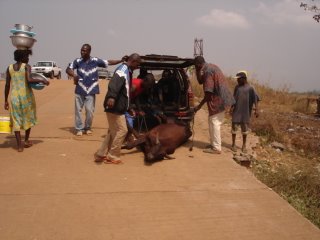 As we pulled into the town to buy some things from the next market, Patrick and I played what-car-do-you-think-that-sound-is-coming-from and some name-that-screaming-animal, carefully listening to the cries of pigs, sheep, goats, guinea fowl, chickens, roosters, and cows coming from various still and moving vehicles in the glorified parking lot that was the town centre. Eventually we saw a very low riding station wagon taxi with the back seats taken out stagger by with only one set of large horns behind the driver’s seat. Guess the second cow brought them a sufficient amount of trouble, and that evening we enjoyed some delicious goat soup, with a mild taste of plantain in the meat.
Christmas Eve we were off to Accra to spend Christmas there, because Christmas day with your parents is “un-cool” and should instead be spent at the beach with friends. I went to my friends Cheryl and Janice’s house for Janice’s airport send-off. As we sat over beer, effortlessly evading the subject of Janice’s departure, laughing and forgetting that we may never see each other again [exactly how send-offs should always be], I started to feel stiffness in my neck, as though I was catching a cold. An hour later, we were back at home [minus Janice], and I had a fever. Just one hour later, I had a raging fever and was deliriously slipping in and out of consciousness.
I want to take a moment to appreciate patient-centred health care and to thank all the nurses and doctors who have treated me all over the world. Going to the hospital in Ghana is basically an Ikea do-it-yourself project with even poorer instructions and barely any English translation. Luckily for me, I brought my own nurse, Cheryl, who has no medical training but did a much better job taking care of me than any of the hospital staff.
I lay on the wooden bench. The nurse sat in her chair across the room. Cheryl ran around the hospital filling out forms and paying fees to get me admitted. The nurse remained unaffected by my presence. Once the appropriate forms and payments were made, the healthy and able-bodied nursed had Cheryl bring the sick patient who was unable to lift her head 15m to sit in a chair in front of her.
-What’s wrong.
-She’s very sick. We think it’s malaria because one week ago, she forget to take her malaria tablets two days in a row and it takes one week for malaria symptoms to sink in.
-Here. Take her temperature.
While this was happening, some friends carried a man soaked in blood and covered in stab wounds into the hospital from a taxi. The nurse sat in her chair. She told them that he couldn’t be admitted and they sped back hoping to retrieve the taxi. It was then that I remembered the formidable undertaking of finding someone to receive me once we had gotten to the hospital. We drove around the hospital in a taxi for almost 30 minutes while Cheryl asked doctors, security guards, and nurses where admitting was. We used every communication tactic we could think of. “Where’s admitting? Entrance? Reception? Opening? Introduction? Malaria! Malaria! Where do we take malaria?”
Once Cheryl had taken my temperature for the nurse, she found a wheelchair to transport me to where the doctor was sitting in his chair.
-Here. Take her temperature.
Cheryl took my temperature again, and after accepting that I wasn’t on drugs, the doctor wrote a list of things I would need from the pharmacy while they kept me overnight at the hospital. Among the items were drip bags, shots, water, and pills – things I would have normally considered as being included among the services provided by the biggest hospital in Ghana, and not being expected to be fetched by ill patients.
The nurses. It’s difficult for me to describe the inappropriateness of the nurses. There was one nice nurse. The others decided that this was the moment that I should learn Ga [despite the fact that I live in a Twi-speaking region of Ghana], and barked commands at me in Ga and imprecise English. One nurse started blasting her radio at 3am. If you ever get sick in Ghana, bring your own Cheryl.
Christmas. They never tested me for anything, but I didn’t feel any better until 6 hours after I was admitted and had had 2 drip bags and several ass shots. Among the things I was treated for was malaria, gastro-intestinal ailments, infection, and dehydration. What was really delightful though was reading all the Merry Christmas text messages I got while laying in the hospital bed fearing the nurses. Almost every hour throughout the night, I received text messages from all over the world. Though normally considered an inappropriate hour to send me a text message, I cannot advise you how lovely it was hearing from all of you from my hospital bed. You’ll never send a text message to a more appreciative recipient than me that night.
The doctors converted all the liquids they had been injecting me with into pill form and released me from the hospital later that day. We went home, my insurance company phoned me, and I managed to talk to my family. While on the phone, my sister mentioned that my Christmas present “is in your inbox”.
Ando’s plane from Casablanca was landing at 5.30am on boxing day, and even 7 hours before she landed, I was unable to walk around without Cheryl’s assistance, and even then I could only go 2 blocks from the house.
-The bad news is that I have malaria. The good news is that I can walk!
Miraculously [perhaps my body was sensing imminent hosting duties] I was strong enough to pick her up by 6am, and after 3 days of general weakness and sticking to cities with hospitals [and one more visit to a hospital in Cape Coast, and waking one morning to find myself half-paralysed down my left leg due to cramping from a particularly brute ass shot, and 2 weeks of being unable to extend my right arm, black, green, purple and blue from the doctor’s shoddy IV insertion job], we managed to pull off some pretty rustic travels to some remote parts of the country, making it to within 19 km of the Cote D’Ivoire border through the bush.
New Year. We spent a low-key New Year’s Eve at a Monkey Sanctuary between two villages. We toasted to the fact that I had finally finished my meds that couldn’t be taken with alcohol, and danced with some of the villagers until a whopping 10pm bedtime [very late by Ghanaian standards]. We counted down Istanbul’s New Year [or whatever city happens to fall into whatever time zone is two hours ahead of Ghana’s] and went to bed so that we could set off the next day to trek out to see wild hippopotami. But that’ll be the subject of another letter.
When I did eventually check my inbox I found a message from Oxfam unwrapped telling me that my sister and brother-in-law had bought something on my behalf to be sent to a needy family in a developing country. The link wouldn’t work, but when I went to Oxfam Canada’s website to see what was available, I was charmed to see that among the donkeys, cows, and food baskets, there were indeed goats! How fitting – someone got a goat for Christmas after all.
 I have heaps of writing to do, especially since my fabulous Christmas adventures with Cheryl, Ando, and Pat, but in the meantime, here's a photo documentary of some of my travels around Ghana, trying to avoid my housemate. www.photobox.co.uk/lgudaiti@alumni.sfu.ca Album - ::Ghana:: Make sure you view them as a slideshow, setting the speed to 2 seconds. Otherwise long and tedious. Once you get to "East Coast", they are older pictures you might have seen. But if you can last that far -- through Mole National Park, Cape Coast, Elmina, and Rasta Adventures -- there are some decent shots to be seen. Naturally, none of these are from my camera [still haven't resolved my ethical issues about photographing here], but I did take some of them with Cheryl and Pat's cameras. Wishing you a merry new year...
[Me sitting in an elephant's footprint]
-X-mas [pronounced “x” and “mas”] is in the air. Can’t you feel it Obaa yaa?
-It’s really hot this week – I can barely even sit at a computer for more than an hour. This is the hottest week since I’ve been in Ghana. To me, Christmas is inseparable from snow. The only thing I feel in the air is the Hamatan.
-Exactly! The Hamatan means X-mas is just around the corner!
The Hamatan is a fog that blows in from the Sahara desert during the month of December and lasts about a month. Though it is far more noticeable up north, away from the mitigating effects of water and forests, where the desert air is transformed during the Hamatan season. While I was up north for two weeks, my nose was bleeding, my lips were chapping, and my eyes would dry up easily. Not exactly Christmas-inspiring.
I think I always imagined the Equator kind of like a red clay Arizona desert, where the ground is cracking, vegetation – and signs of life in general – is lacking. Though where I live in the mountainous jungle is actually closer to the Equator, the north of Ghana really looked like how many people imagine desert savannah [and poverty] in Africa. And much like how the rain is blamed for everything during the rainy season where I live, anything that goes wrong in the month of December is blamed on the Hamatan.
-I keep forgetting to write Christmas cards because it’s too hot to remember that Christmas is around the corner.
-You are not a Christian. You can’t send CHRISTmas cards!
-Well, I’ve had no luck finding ‘season’s greetings’ cards. What must I do?
-I don’t think you should send X-mas cards if you won’t accept Jesus Christ as your saviour.
-You are intolerant.
As usual, Personnel Officer is testing my belief system, systematically trying to find holes in it so that he can pounce with a Christian explanation. He has recently enlightened me to the fact that capitalism is indeed a Christian construct, and we are still in heated debate regarding how much of an influence Christianity has on democratic values of equality and the Enlightenment.
-Evelyn, don’t invite Obaa Yaa anywhere for Christmas. If she’s not a Christian, she shouldn’t celebrate Christmas. What do your people celebrate anyways? Do you worship the sun?
-Yah, kind of. In the bleak mid-Winter, I usually go somewhere hot to soak in some vitamin D, and my sister and I try to remember to celebrate the winter and summer solstices. I also celebrate Hallowe’en and Thanksgiving. And for Easter, I try to eat rabbit. Oh, and I celebrate Buy Nothing Day.
-What’s that?
-It’s a day you don’t buy anything. It’s intended for us to re-think our consumption-based economy. In my culture, everyone’s trying to buy their way into happiness. If I have this, I can do this, and be happy. We’ve completely lost sight of what is supposed to be the end goal, distracted by all the stuff we’ve forgotten we don’t need.
Last week I was doing field work with my boss Michael, going to villages in our municipality and inaugurating Community Implementation Committees for the European Union’s Micro-projects programme. Between inaugurations, I found myself in the village of our driver, Mr. Ankara [who also happens to be my Ghanaian father], drinking palm wine and shopping for goats at 10 am. I, of course, got no explanation about what we were doing.
-I’m certainly happy to sit here drinking palm wine all day, but I must ask, what the hell are we doing here?
-I’m looking for a goat for my father for Christmas.
-How much does a goat go for?
-Depends on the size. He wants 500 000 for that one, I’m giving him 350 000 [$50 and $35 respectively].
-Can you get a female? Then I could come over and milk it.
-Why would you want to do that?
-I’m allergic to cow milk and the store hasn’t had any soymilk in almost a month. It’s such a waste that there are so many goats everywhere, yet no one seems to drink their milk. Every morning I wake up to a goat belting at my window from my front porch, yet I still have to drink my coffee black!
He bought one male goat for himself and made plans to come back for three more goats for family members. We took the goat in the boot of the truck and went to inaugurate some more committees. I sat in the truck delighted by what had just happened – a goat! As a Christmas present.
Every year around this time, I compile a list of alternative holiday gift ideas. Eventually, I turned this list into a website, but apparently I don’t have a website anymore. The list is nothing original – plenty of websites exist that are all advocating for a more reasonable and responsible way to exercise the spirit of giving. Some argue environmentally-friendly giving, some argue socially-responsible gifts, some argue to give services rather than stuff, and others say not to give anything at all
I have been very fortunate to be constantly inspired by ideas and discussions that happen at my dinner table back home. I remember when I was a teenager, my sister, brother and father finally had enough consensus to democratically defeat my mother and my traditional values of having a real Christmas tree, and we have had an environmentally-friendly fake Christmas tree ever since. Over the years of birthday, Christmas, and travelling presents, we have grown to a position where we are allowed to give each other things only if it’s something that really leapt out and struck us as being something the receiver would enjoy, or if it was some sort of service.
An example is that last year for my father’s birthday, we all chipped in and had the piano tuned for him. My father loves to play the piano, and anyone who knew me in Vancouver is familiar with the sound of a piano playing in the background whenever they spoke to me on the phone. Rather than contributing to the pockets of some multi-national corporation who needs our money less than we do, and rather than contributing to the mass amounts of wastes that are produced annually from consumerist goods, we contributed to the local skilled-labour economy and hired a service. [And having the piano tuned also has obvious selfish benefits for the gift-givers too!].
So, next time I feel like it’s Christmas, you’re all getting goats, as long as you don’t mind if I come over to milk it every now and then. Under certain conditions, it can be as good to give as it is to receive, and livestock is certainly a gift that keeps on giving.
This is something un-intelligent that I wrote in a moment of frustration, which embellishes a little. It's more of a letter to all people who approach me on the street as if I can just hand out visas to whatever country they assume I come from. I have much more interesting things to say on this subject, especially after reading about the recent conference on migration and the Lybian president's comments on migration being a natural right of humans. Once I've settled into a new home, I'll hopefully have the opportunity to write about it. In the meantime...
I come from North America, a continent whose current shape was built on immigration. When my family arrived in America from a refugee camp in Eastern Europe, the “American Dream” of coming to a young country, working hard, and making a good life for one’s self was still viable within a generation.
The world is a very different place now. The middle class has been filled and the only vacancies left are at the foot of the social ladder. People who were doctors and university professors in their home countries come to North America and are the lucky ones if they find work as taxi drivers or janitors. For people who come from situations where their basic security as human beings was being comprised – coming from war-torn countries, desperate poverty, political prisoners – immigration may be a necessary transition for them. But for people who live a secure, safe, and relatively comfortable life in their home countries, who hope to immigrate for an imagined “better” life abroad, I hope to un-veil some of the realities you should expect if you were to go to the North American countries of the United States of America or Canada.
Every country seems to suffer from youth unemployment these days, and North Americans seem to be dealing with this problem by spending their 20s in universities rather than learning a trade and being almost immediately employable. People who are competing for white collar jobs are extremely educated in North America, and you will find that many North Americans who sell shoes and serve food have Bachelor degrees and even Master’s degrees sometimes. Arriving immigrants have to compete for good jobs with people who: (1) are experts at local social and cultural norms; (2) have an average of 2 years more education than their job requires; (3) speak the local language with perfect clarity; and (4) have more connections to the higher rungs of the social ladder. Many immigrants feel they need to lower their salary demands just to compete in the North American job market, adding to the existing financial obstacles that they had not anticipated, but that come with life in highly developed countries.
The cost of living. Highly developed countries are nice places to live because people spend most of their money on them. In Ghana, most people’s income goes towards food. In North America, someone who earns a decent wage of $40 000 per year will pay roughly half of that to taxes. Rent in major cities usually costs another half of your monthly income. In the winter, your heating bill can cost as much as half of your rent. That leaves about $80/week for food, entertainment, clothes, and lifestyle. That’s $11/day. A coffee costs $2, a very cheap lunch is $5, and a Guinness is about $8, not including taxes and tipping your waiter. When you add all the costs of living, at the end of the month you won’t have enough money to access the lifestyle you came to North America for. The lifestyle you seek will still be some distance away.
It’s not an easy life. I have a friend who is a European-Canadian with an English name who has a Master’s degree in the fastest growing field in the UK. He went to London equipped with all of these assets and, after struggling for 8 months, has decided to go back to Canada so that he can enjoy a proper meal and have enough money to have some sort of lifestyle.
The social ladder. A person’s lifestyle largely depends on the context they live in. In peaceful countries like Ghana, where the most basic human needs are generally provided for, the bulk of society has a relatively comfortable lifestyle. The lifestyles of my work colleagues here in Ghana are roughly comparable to the lifestyles of my work colleagues in North America. They live in houses, some of them have cars, they can feed their families and take care of some desperate relatives, but can’t afford too much travel. How we judge ourselves is always relative to where we place this bar of what we consider to be “normal”.
My mother once said that when she was growing up in America in the 1950s, they had nothing compared to what children in America have today. But since everyone was under these same circumstances, they didn’t feel like they had anything less than what was needed, and everyone was happy. A child today with the same standard of living as my mother in the 1950s would be considered deprived and would feel ashamed of their few possessions, being aware of the many possessions their classmates have. The norm of what we “need” is now higher, but we certainly don’t consider ourselves as being any happier. After providing for basic human needs such as food, water, shelter, and security, possessing a higher standard of living has no ceiling – both the developed and the developing world keeps “needing” more things, and I hate to think how much plastic will be wasted just so that children in 20 years can keep pace with their friends.
When immigrants come from a comfortable lifestyle in their home country to a new life in North America, they loose their standing as being in the same financial condition as everyone else. Immigrants often work more hours, do much more labour-intensive work than they are accustomed to, and at the end of the day all their struggles still result in a lower than “normal” standing on the social ladder. Immigrants may need to struggle like this for an entire generation before attaining “normal” standing in their new country. The only respite from this cycle is when they can send their surplus $50 per month (about 500 000 cedis) back home so that somewhere, someone can benefit from their labours. Many Ghanaians who live abroad don’t come back because they can’t afford the plane ticket.
People work hard all over the world. Immigrants who have been very successful in their new countries worked very hard to get there – they were innovative, smart, entrepreneurial types who probably struggled for years before reaching any success. Easy is not a place on this Earth. You can’t get a visa there and making friends with foreigners won’t buy it for you either. Foreigners may seem rich to you while in Ghana, but most of us have a comparable life in our home countries to yours here in Ghana. It’s only when we take our currency across the border into countries with weaker currencies that we can feel big about ourselves.
That’s something that’s very un-fair. Currencies and passports from the “developed” world can get you into most countries in the world while currencies and passports from the “developing” world cannot. When one country’s economy is stronger than another, the stronger economy country does not want everyone to flood into the country and burst their economy, so they limit the access of people from poorer economies to come to their country. People from the world’s strongest economies pose little threat because they are un-likely to want to work in a country with a weaker economy than their home country. We are welcomed with open arms into most countries because we come to spend our money, not to earn money that would otherwise be earned by a local national. But currencies fluctuate, economies grow, and new resources can suddenly become extremely valuable on world markets, changing people’s access to the rest of the world.
You may still want to experience all of this yourself, and maybe your immigrant experience would be different than what I have just described, but I think it’s important to leave with appropriate expectations. Ghana is a peaceful, friendly country, where people enjoy more personal security than many cities in the developed world. A “better life” is not necessarily geographic or across the Atlantic Ocean.
It’s really sad that the current condition of the world is such that some people have a lot while others have so little. It makes a situation that is uncomfortable for both the haves and the have nots, and the larger the gap, the larger the discomfort. Where people are desperately poor, rich people need to build a wall around their material and human assets, protecting themselves and their families with bodyguards, security systems, or, if you’re in Africa, a 6-foot concrete wall embedded with broken glass perilously sticking out of the top. The more obviously valuable you are (i.e. the more obvious the gap is between you and "them"), the more devices you need to protect yourself.
When traveling, you are constantly being sized up as a potential source of political, economic, social, and/or cultural gain, as well as a source of escaping a current condition for some imagined easy life elsewhere. The list of questions tourists are relentlessly asked represents this: "Where do you come from?", "What do you do?" and "Are you married?" This sizing up exercise is, of course, not restricted to travelers in developing countries – in our home cultures we ask a similar line of questioning and how we introduce people also reflects these values. This is how we construct our social world, how we understand our position in comparison with others, revealing at best potential sources of intriguing conversation, at worst, opportunities to advance one’s own status through a new connection in their network. Eco-tourism is one approach to lessen the negative aspects of the visitor-visited dialectic, claiming to offer a more genuine and beneficial experience to all parties concerned.
I am the second Canadian to be working in my office of 80+ employees, most of whom are men. It has been very easy for me to make friends at the office because the last Canadian made an excellent impression on everyone, and I was almost instantly welcomed into the office family. The half-dozen women in my office live a very different reality than I do though, and my closest friendships have been with some of the men. In the 1980s, the Soviet Union sponsored many Ghanaians to study in Moscow, and I enjoy discussing Soviet Russia, socialism, capitalism, religion, belief systems, culture, and society with these colleagues. After work, I never have any trouble finding someone to join me for a beer so we can continue our intriguing conversations.
After a few weeks of familiarizing themselves with me and the history of each of the five rings I wear on my fingers (ie. learning that none of them is a wedding band), I was suddenly being very actively pursued by some of the men at my office. Everything seemed under control though, as I insisted that I would never be involved with someone I work with. I even explained that, as a woman, it can be difficult to be taken seriously as a professional sometimes, and so we must insist on maintaining professional boundaries and not give any ammunition to those who would suggest that our achievements were due to something other than our own merit.
This week, I made some discoveries about the nature of some of office friendships though:
1. After failing to secure the affection of the first year’s Canadian, the men in my office settled on a queue for who would have first dibs on the second Canadian at the office. This queue was roughly decided on before last year’s Canadian had even left Ghana.
2. The order of the queue exactly conforms to the order of people who have been obviously pursuing me in the last few weeks.
3. Some of the strange middle-of-the-night phone calls I have been receiving were coming from these pursuer’s suspicious wives.
4. All of these efforts were in the pursuit of wanting the freedom to travel.
There’s a lot I could say about this. In fact, there’s a lot I did say about this to my Canadian colleague in Ghana who is doing on a similar assignment as me, though he’s male and is in a different district.
-Do you see what I have to deal with? If it wasn’t difficult enough strategising ways to avoid these discomforts from strangers on the streets here…
-Wow. How does it feel to be such a piece of meat?
-Piece of meat? I was prepared to be a piece of meat! I endured being a young 6 ft blonde living in Italy and Turkey. At least as a piece of meat, you can construct some idea of what’s behind the flesh. Someone could like your style, the confidence in how you present yourself, the sincerity in your eyes. This apparent list of romantic hopefuls was decided on before I even arrived. I don’t even get to be a piece of meat – I’m a piece of paper!
Later in the week my informant asked me how I felt about these four pieces of information I had learned:
-I guess mostly I’m disappointed. There are so many people traveling around the world who want a more genuine experience than the façade we are offered as tourists. We care about people and want to better understand realities of the human condition. So we work hard and come to countries like Ghana to offer our time and services in exchange for a more sincere and authentic experience. But in the end, it’s just another misleading façade that we get to see, except that we were deceived to a deeper, more personal level.
But maybe that’s fair. We have the freedom to see virtually the whole surface of the geographic world. Why should we also consider ourselves to have the right of access to all of its depths too? The freedom to leave comes with a limit to how much you get to see. A Ghanaian passport won’t get you into many countries, and the financial condition of a typical Ghanaian will get you into even fewer, but Ghanaians can have a much deeper experience in their travels in West Africa than that which is afforded to the visible minority foreigner who additionally doesn’t understand the subtle gestures and changes in tone characteristic of West African cultures.
You can see a paper-thin version of the world, a slightly meatier version of the world, or a deep and profound version of a few familiar places. Unfortunately, the choice isn’t’ always yours.
Taking a tro-tro and going to the market are two of the most impossible topics to do justice to in print. If you ever feel yourself approaching a mid-life crisis, or need to snap out of the dullness and monotony that can be office life, just take a tro-tro. You will not only feel alive, but you will also be thankful for every living moment, suddenly find yourself thinking “there must be a God” because you’ve spent the last 3 hours defying death and have arrived to your destination safely. You still run the risk of developing lung cancer from all the fumes you’ve inhaled en route, and I’m unaware of the long-term effects of exposure to goat feces in a closed environment, but you’ll kiss the ground if/once you arrive safely. Despite all of this, sitting as a passenger on a moving vehicle viewing a landscape is probably my favourite activity to do while travelling. Here is my best attempt at capturing the experience in Ghana…
As far as I understand, Ghana does not actually have a publicly-run transportation company, but what I am trying to capture in the title is that I have been using the same cheap transport that locals use. Not the air-conditioned, safe-like, comfortable modes of transport usually associated with foreigners travelling in developing countries. Ghana does have two bus companies with this class of travel available, and if I lived along a route that was served by a safer means of transport, I would definitely use it. Unfortunately, I live in the mountains where only tro-tros seem available.
According to my guidebook, a tro-tro is “pretty much any passenger vehicle that isn’t a bus or a taxi…ranging from crowded minibuses to customised covered trucks with densely packed seating, a pervasive aura of sweat, no view, and not much more chance of finding an escape route should you be involved in an accident.” All the tros I’ve taken here are between 14- and 22-seater vehicles which could be described as military vans, where the only seatbelt present is for the driver, although the coveted front passenger side seat sometimes also has a seatbelt. Generally on the tro you pay for your seat, but leg room and head room are not guaranteed, and you will inevitably need to concede part of your seat space to the two or three people in your row who exceed their own seat’s capacity.
We westerners like to depend on signs and other forms of print rather than on people when we travel. Deal with it – in Africa, you just need to accept that you are always at the mercy of strangers. Once you find the station, everyone will start asking you where you’re going – at first, I walked straight past these people, because years of travelling has taught me that anyone who approaches you in tourist areas like stations are trying to cheat you – in Africa, these people are your best source of the most accurate information. Expect it to take about an hour to find your tro-tro, and then expect another hour or four for your tro to fill up.
As you and the other 21 people sit baking in the oven atmosphere characteristic of an un-moving vehicle sitting in the equatorial sun, every crevasse of the vehicle which could otherwise act as a passage for wind to ventilate the suffocating interior of the tro, is instead occupied by someone trying to sell you things. Since the competition is so fierce, vendors need to be creative with their attention-grabbing tactics. They also need to have eyes on the backs of their heads as hundreds of tros are being shuffled around the station to maximise parking space.
I’ve never seen organised chaos like in a tro-tro station, or any Ghanaian street intersection for that matter. My first time in a busy tro-tro station in Accra seemed like a cartoon version of real life. The nerve of the tro-tro drivers and their skippers – the intimidation tactics and parking manoeuvres used to assert their right to a space in the station, in the intersection, along the bank of the highway – is quite remarkable. Every centimetre of the station/intersection/road not occupied by a vehicle is filled with a 14 year-old carrying products on their head while shouting “aaaa-eeeee-sssss-uuuuu-wwww-aaaa-tttt-a”, “mmm-eeeeeeeeeee-ttttt-ooooo pp-eye-wa”, “beeeeeeeee-sssss-kkk-it-wa” and my favourite, “o-rrrrr-e-n-g-eeeeeee” [ice water, meat pie, biscuit/cookies, and oranges].
It’s a toss-up – is it better to get one of the last seats on the tro, meaning you don’t have to sit uncomfortably in the heat waiting to depart, or whether it’s better to be the first on the tro, affording the opportunity to choose your seat. You often have to choose between time and comfort, though I have had one or two tro-tro skippers ask people to offer the front seat to me because I couldn’t actually fit my legs into the only seat left available in the back. However, I also spent 6 hours on a tro-tro where my knees didn’t fit between the seats, so I had to sit on an angle with a tiny sliver of space for my legs, my luggage on my lap, and a goat under my seat. A few times when my legs began to cramp and I had to bend them under my seat to stretch them, the goat started to pull at my shoes.
Once the entire floor surface area and air space of the tro is finally filled, your driver will begin the journey of ploughing through people and vehicles to exit the station. My tro yesterday from Accra took 15 minutes to get out of the station and another hour to get out of Accra. At every bottle neck, a group of vendors is gathered waiting for their prey to get stuck in the web of traffic. On the road to Kumasi, there are 3 construction zones where only one lane of traffic can pass, and a community of about 100 vendors has formed at each one to sell to vehicles waiting for on-coming traffic to pass through the only available lane. What an entrepreneurial spirit – collectively there must be about 300 people who have set up these temporary communities along the highway construction schedule, who arrive every morning from their communities with their goods to sell. I should also note that along the Kumasi-Koforidua corridor, I saw the remnants of an oil truck that had vered into on-coming traffic and into a house on the other side of the road, and evidence 5 other severe car crashes.
The journey is spent with Ghanaian music blaring from the speakers, interrupted by passengers yelling at the driver for not being more careful, or for going over a pothole too quickly. Most of the main roads are paved, but since traffic is such an issue drivers often take one of the many clay road “short-cuts” which zig zag through quiet communities, trying to catch enough speed to both intimidate locals out of crossing the street and to be air-born over the potholes. When the drivers play lively Ghanaian pop music it can really add to the thrill of the ride. I’ve also been on tros which played calm and peaceful Ghanaian gospel music – it was quite surreal being enveloped by smooth, serene sounds while you're clinging to the dashboard in front of you, trying to prevent yourself from going through the windshield into the people and vehicles flying past you .
But these are also the moments I am most inspired. It’s on the tro that I saw my first real African slums, saw the roaming hills by moonlight, and most of the thoughts I’ve contemplated here first struck me while sitting on a tro-tro, hoping our vehicle doesn’t strike someone else.


